What is engineered wood flooring?
A wood top layer is bonded to one or more supporting layers. This construction limits natural movement but does not eliminate the response to humidity changes. Solid boards are made from a single piece of wood. Typical laminate has a decorative surface rather than a wood top layer intended for refinishing.
Two layers or three?
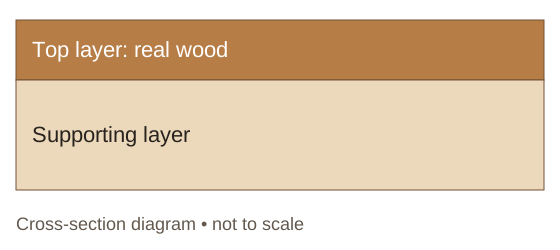
Two-layer boards combine a wood top layer with a structural backing, for example timber or plywood. Three-layer boards also have a bottom layer; in a typical timber construction the middle layer runs across the outer layers. Layer count alone is not a quality ranking.
Two-layer board
Three-layer board
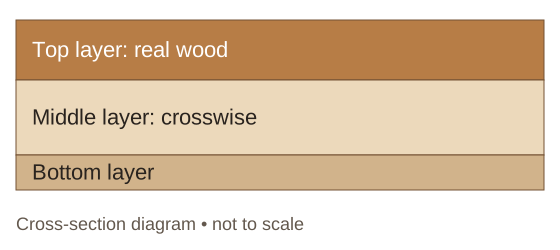
Diagrams are illustrative and not to scale. Finish, adhesive and joint profiles are omitted. Check top-layer thickness in the product data sheet.
When should you choose wood?
When natural grain, variation between boards and refinishing within the product’s limits matter to you. A sample shows only part of the material: the full floor can vary in shade and knots. Check the wood grading description, format and finish.
Allow for maintenance, possible scratches or dents, and the manufacturer’s indoor humidity requirements. With pets, frequent water exposure or expectations of a surface without signs of use, compare other materials too.
Glued or floating?
Check the model’s instructions first. Not every board allows both methods. For example, BOEN’s two-layer instructions specify full-surface bonding; some three-layer boards permit both glued and floating installation.
| Criterion | Glued to the subfloor | Floating |
|---|---|---|
| Connection | Boards bonded to the substrate with suitable adhesive. | Elements joined together without bonding the complete floor to the substrate. |
| Preparation | Check flatness, moisture, surface strength and adhesive compatibility. | Flat, dry, stable substrate; underlay meeting the instructions. |
| Heating and noise | Assess the board–adhesive–substrate assembly. | Include the underlay’s thermal resistance and acoustic performance. |
| Work planning | Allow adhesive curing before loading. | Check expansion gaps, transitions and restrictions around fixed furniture. |
Gluing does not remove the need to plan expansion joints. Floating installation does not permit an uneven substrate.
Oil or lacquer?
Oil: understand the specific finish’s periodic care and renewal requirements. Natural oil, UV oil and hardwax oil may need different treatment. Check local repair options, particularly on coloured surfaces.
Lacquer: creates a protective coating that also wears and needs suitable cleaning products. Repairs may differ in sheen or colour from surrounding areas. Do not select lacquer-care products from instructions for oil.
Ask for care instructions and inspect a sample before buying. A matt appearance alone does not identify the finish.
Subfloor, heating and everyday use
- Moisture: measuring substrate moisture and monitoring indoor humidity are separate tasks. Establish requirements for both; excessively dry or humid rooms can cause dimensional changes.
- Heating: check approval for the specific system, total thermal resistance, temperature limits and heating-screed preparation records.
- Water and dirt: remove spills and grit, protect furniture feet and use approved care products. Oil or lacquer does not make every board suitable for a bathroom.
- Height: allow for boards, adhesive or underlay, and levelling. Check doors and tile transitions before buying.
Can the floor be refinished?
Distinguish refreshing the finish, local repairs and sanding wood. Scope depends on the remaining top-layer thickness, damage, previous refinishing and the finish itself. Sanding may alter colouring, brushing or bevels.
We do not promise a set number of sanding cycles from overall board thickness. Refinishing needs a floor assessment and a method compatible with the product.
What should you prepare for a survey and quote?
- A plan, area measurements, location and preferred timing.
- Photos and information about the substrate and heating.
- The model name, construction, finish and installation instructions.
- The pattern, skirting, transitions and fixed-furniture layout.
The quote covers the agreed scope: removal, repairs and levelling, installation materials, laying and finishing. Compare the same work scope. LaFloor provides installation; you purchase the flooring independently.
Explore parquet and herringbone patterns
Sources and documentation
- Barlinek: three-layer construction (PL)
- Jawor-Parkiet: construction and finishes (PL)
- BOEN: two-layer installation (PDF)
- Barlinek: installation, heating and use instructions (PL)
- Barlinek: care (PL)
These manufacturers’ requirements apply to their products, not universally to all engineered boards.